The Story of Civitas Gaya
We were few when we awoke. No angels, no devils - just a few dozen confused people in metal corridors under alien light.

The Awakening
We were few when we awoke. No angels, no devils - just a few dozen confused people in metal corridors under alien light. Earth's records list us as missing persons, accident victims, casualties of war. All I remember is the smell of metal, the soft vibration of the walls, and a warm glow that was not a sunrise.
Through a round porthole we saw Helion for the first time: larger than the sun, more golden, quieter. We later learned that people on Earth call it Epsilon Eridani - an orange star just over ten light-years away. Below us lay a planet, half wrapped in clouds, half in dark expanses of ocean and forest. Gaya. Whoever had brought us there kept silent. Those we now call "the Architects" could only be sensed through their preparation: domes, tanks, seeds, tools, simple machines. Enough to survive - but no manual, no orders. It felt like: "Here, try it. We're watching."
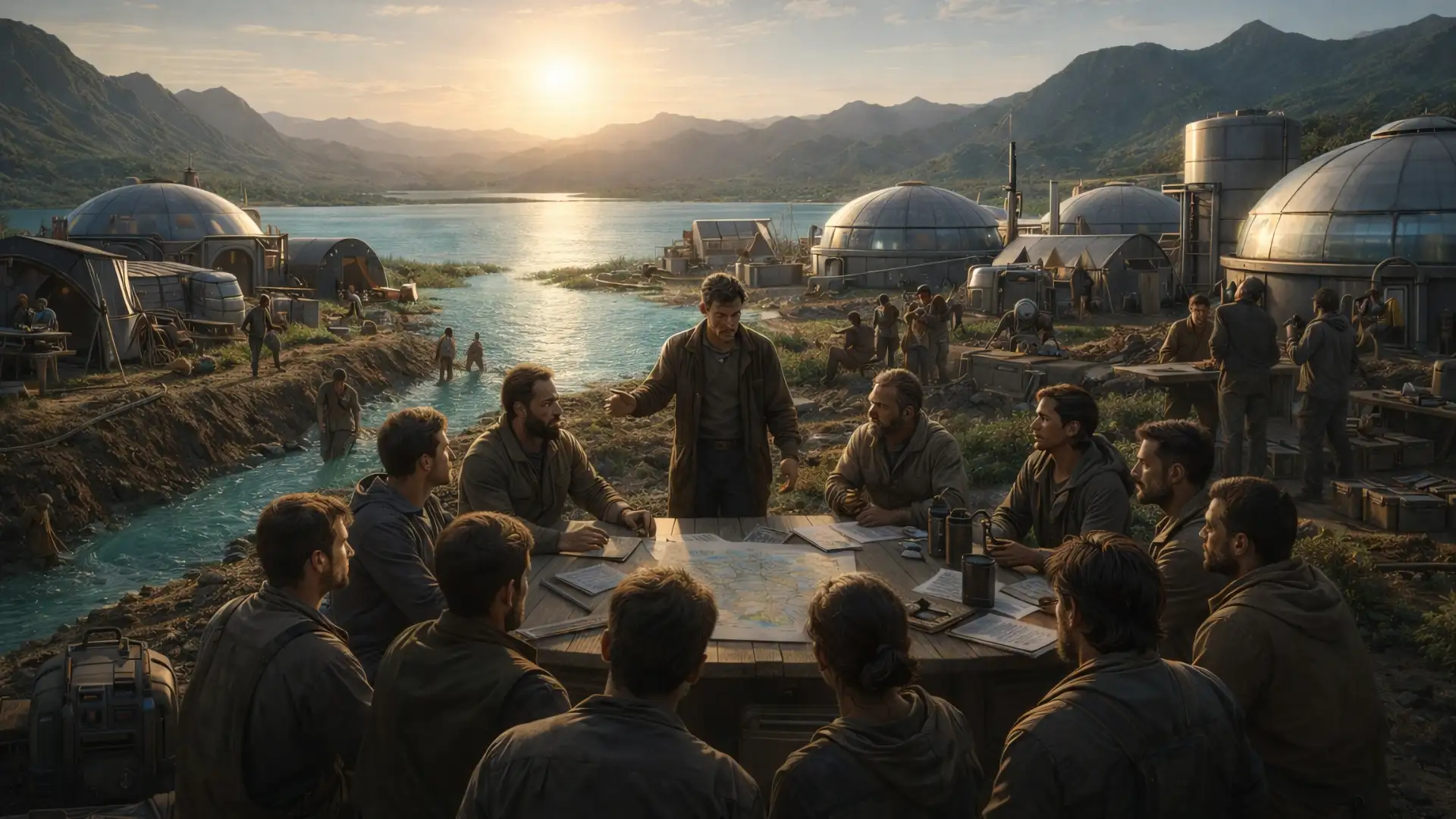
On Gaya nothing was self-evident. The forests were dense and dark, some plants shimmered in the oblique light of Helion, the seas glowed at night as if stars lay in the water. The air was breathable, but capricious - a single storm could wipe out an entire settlement.
It became clear quickly: there was no room for kings. So we sat down together - everyone affected. And that was always all of us.
The First Councils
The first councils did not emerge from theory, but from hunger and fear. Who could fix water pipes? Who understood plants? Who could defuse a dispute before someone turned a tool into a weapon?
We decided that no one should hold office permanently, that important decisions had to be justified and recorded, and that every person affected by a decision must at least be heard. At first this was pure pragmatism. But with each winter we survived this way, it became a principle: power must not stand still, it must flow.
Over the years we settled only a narrow belt of Gaya: a chain of valleys, lakes, and sheltered coastlines where climate and soil were reasonably reliable. We brought our plants, our microbes, our stories - and placed them alongside what was already there. From this emerged a new, fragile order: neither pure colony nor mere adaptation.
The Architects remained silent. Instead, other actors stepped forward - disturbances, patterns, probes. Structures in orbit repaired themselves when we attacked them. Signals pointed to intelligence, but not one that had our survival as its goal.
To these Others we were data points, interference, or raw material - not partners.

The Hard Question
At some point we faced a decision that divided us more deeply than any storm. Some said: "We must centralise - strong defence, clear chains of command, one council above all councils. Otherwise we perish." Others pushed back: "If we sacrifice our councils to survive, does Civitas Gaya survive - or only a new variant of the same authority we fled?"
We argued through nights, voices grew hoarse, protocols grew longer. In the end, one bitter insight remained: if our values are to be more than fine words, we cannot sacrifice them for a war we did not choose. The third option was the hardest: leave. Not all, not at once - but enough to secure a future elsewhere.
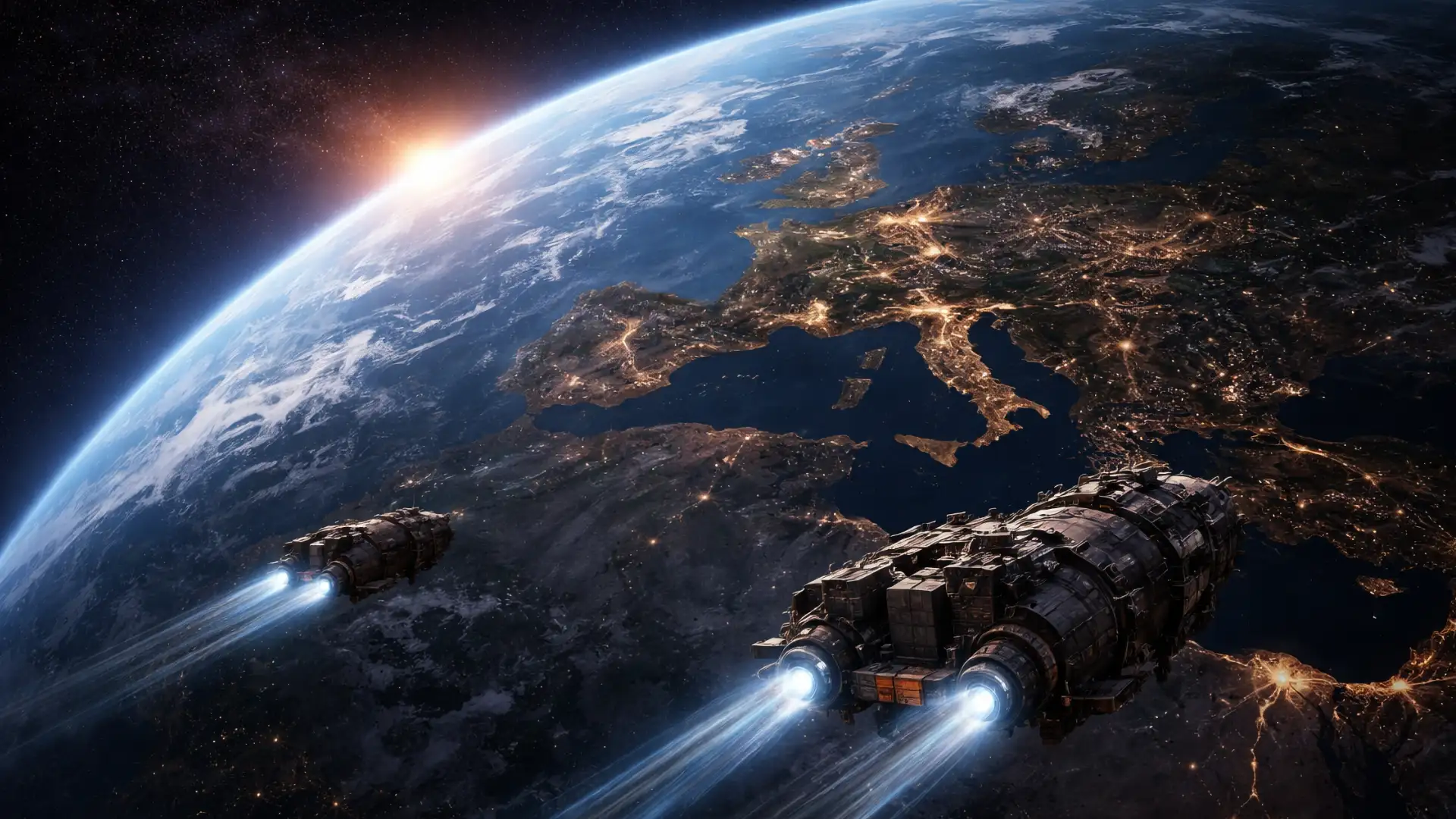
Over decades our engineers and researchers had taken apart and reassembled relics of the Architects: drives that hook into the fabric between the stars; habitats capable of sustaining a small community for a long time; navigation that reads not just stars but the fine murmur of the galaxy. From this came no proud fleets - but boats for a quiet evacuation.
Return to Earth
Earth was no myth to us - it was a radio signal with coordinates. We knew that states, borders, and old forms of authority existed there. But we also knew that people lived there who had words for justice, dignity, and resistance. It was not a safe harbour, but the only place where our story could be understood at all. So we set out in waves. Some of our vessels reached Earth; others we lost sight of.
On Earth we scattered. We took new names, found work, started families. Much of Gaya fell silent - out of fear of not being believed, out of exhaustion, out of the simple desire to be "just" human for once. But certain things persisted: an aversion to blind obedience, the need to discuss important matters in a circle, the habit of writing decisions down and justifying them. Eventually people met who knew the same fragments. From those encounters, Civitas Gaya in Exile was born.
The Foundation Stone
When we gather today around the Gaya Foundation Stone - an unremarkable stone on a table somewhere on this Earth - it matters little whether it truly once lay in a forest beneath Helion. What matters is what we do around it: we tell our story, we give ourselves a constitution, we hold one another to sharing power and raising no one above the rest.
And wherever one of us stands up and says "I am a citizen of Civitas Gaya" and acts by these principles, the ground beneath our feet feels, for a moment, like a piece of Gaya - not as an escape from this world, but as a promise to treat it better than either world has treated us.